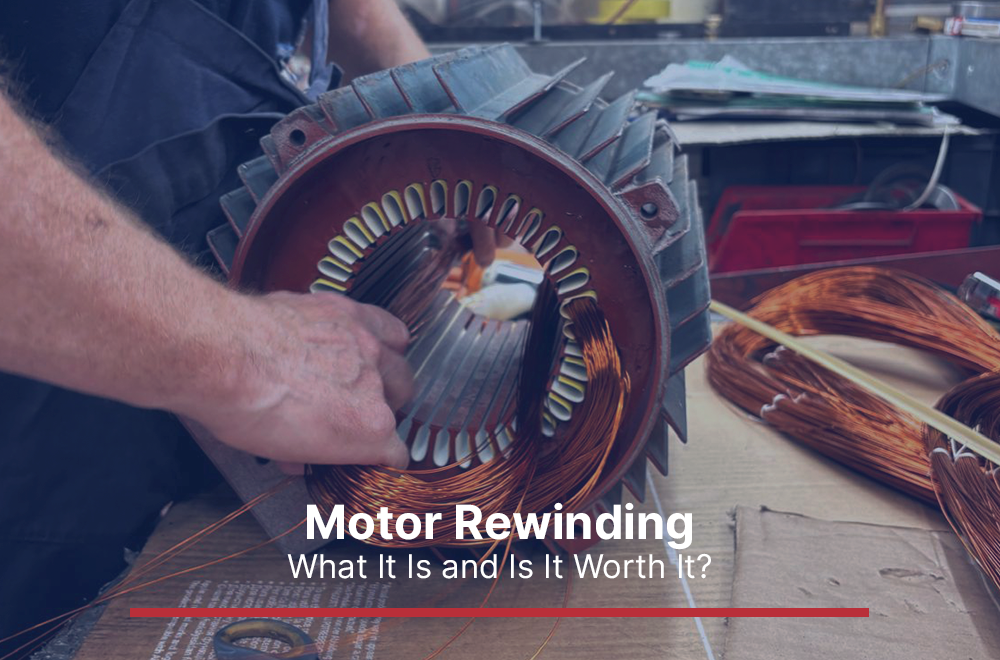
Motor Rewinding: What It Is, How It Works, and Whether It’s Worth It
Motor rewinding restores performance, improves efficiency, and provides a cost-effective alternative to full motor replacement.
February 1, 2026
Why Motors Sometimes Need Rewinding
Electric motors don’t last forever. Over time, a range of factors can degrade their performance, making rewinding necessary to get them back in shape:
Insulation breakdown: Insulation materials can deteriorate over years of heat, overloads or voltage fluctuations, leading to shorts or ground faults inside the windings.
Overloading or excessive load cycles: Running a motor beyond its rated load can put stress on the windings, increasing the chance of failure or burnout.
Harsh operating environment: Moisture, chemical exposure, dust, or severe temperature fluctuations can degrade windings over time.
Mechanical problems: Vibration, bearing wear, structural misalignment or other undue mechanical stress may damage windings, making rewinding the only viable fix.
Recognising these root causes helps companies decide whether a rewind is worthwhile, or whether replacement is unavoidable
What Happens During a Motor Rewind
;Rewinding a motor is a detailed, careful process. Done correctly, it restores, or even improves, the motor’s original efficiency and reliability. Key steps include:
Disassembly: The motor is taken apart to access the stator and rotor. Bearings, end plates, and fasteners are removed to expose the windings.
Removal of old windings: The old (worn or damaged) coils are carefully inspected, and their connections recorded before being extracted, using specialised coil-removal tools or cutting equipment as required.
Cleaning and inspection: The stator core is cleaned of debris, insulation residue or contaminants and inspected to ensure the core and laminations are intact and suitable for rewinding.
Winding design and coil preparation: Engineers calculate the number of turns, wire gauge, slot configuration and insulation requirements. Coils are then cut and insulated accordingly.
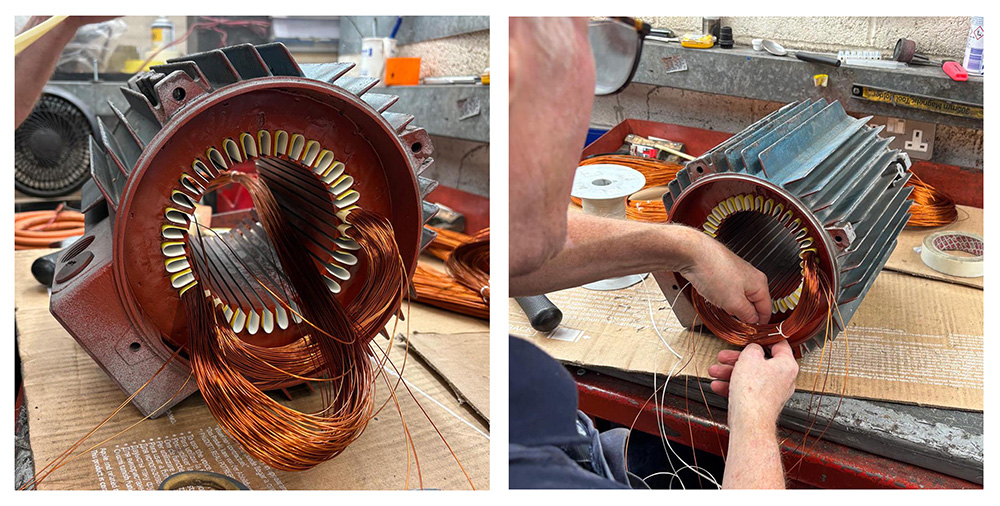
Installation of new windings: New coils are carefully placed into the stator slots, secured with wedges or insulation materials, ensuring secure seating and proper insulation.
Connection & insulation finishing: The winding ends are connected (series, parallel, etc., depending on design), and the entire winding is insulated with varnish, tape or equivalent materials to prevent shorts and provide environmental protection.
Testing & balancing/reassembly: Before a motor returns to service, it goes through electrical and mechanical testing: winding-resistance, insulation-resistance, high-potential (hi-pot) testing, plus a test-run to check for vibration, noise, temperature rise, and overall performance.
This rigorous process ensures the rewound motor performs as intended, or in some cases, better than before.
Why Rewinding Is Often Better Than Replacing
There are several compelling advantages to choosing a professional rewind over a full replacement:
Cost-effectiveness: Rewinding often costs far less than buying a new motor, especially for older, custom, or large motors where replacements are expensive or lead times arelong.
Shorter downtime: Custom or non-standard motors can take weeks to source. A rewind service can often restore a motor much faster, saving your operations from extended downtime.
Sustainability & resource efficiency: By reusing the motor’s existing core, shaft, and housing, rewinding reduces material waste, conserves copper/steel, and lowers the environmental footprint compared to manufacturing a new unit.
Customisation and performance tuning: In some cases, rewinding allows adjustments (wire gauge, insulation class, turns, slot fill, etc.) that can tailor motor performance, e.g. to match a specific load or application requirement.
Extended service life: A well-executed rewind can give a motor many more years of dependable service, essentially “resetting” its electrical lifespan without the need for wholesale replacement.
For many companies, especially those relying on older or specialised equipment, a rewind is the smarter, more practical choice.
Why Using Professionals Matters
Rewinding a motor isn’t a quick DIY job. It requires deep technical understanding, precision, and rigorous testing. Mistakes in wire sizing, slot filling, insulation, balance, or connection can lead to poor performance, early failure, or even safety hazards.
By working with experienced rewind specialists, you gain:
Skilled engineers who know how to handle stator/rotor cores, slot geometry, coil tension, insulation classes, etc.
Proper equipment for coil cutting, insulation application, varnish curing, dynamic balancing, electrical testing, and performance verification.
Traceability and documentation, assuring that repairs meet industry-standard tolerances and providing peace of mind when rewound motors return to service.
In short, professional rewinding offers reliability, repeatability, and quality control, all of which matter for industrial or heavy-duty applications.
When Rewinding Is (or isn’t) the Right Solution
Before you commit to a rewind, it’s worth assessing whether your motor is a good candidate. Here are some typical considerations:
Good Candidate for Rewind ✅
Might Not Be Worth It 🚫
The motor’s frame, stator/rotor core, and housing are structurally sound. Damage to the magnetic core or mechanical parts may rule out rewinding.
The stator core, laminations, or housing are damaged beyond repair.
The motor is older, custom, non-standard, or otherwise difficult/costly to replace.
Bearings or mechanical parts are worn out or suffering structural faults; these might require more than just winding repair.
Downtime or lead time for a replacement would be disruptive.
A similarly spec’d new motor is cheap, readily available, and the total cost difference is negligible.
You want to save money, reduce environmental impact, or reuse existing equipment.
A qualified engineer should always inspect the motor to decide whether rewind is viable.
Bringing This to “City Rewinds and Drives”: What We Offer
At City Rewinds and Drives, we believe in maximising the lifespan and efficiency of your electric motors and drives. That’s why we:
Provide thorough assessments, inspecting stator cores, bearings, housings and insulation to verify rewinding viability.
Use high-quality materials, accurate coil design and precise winding methods, tailored to your motor’s specifications and application requirements.
Perform full testing before returning motors to service: insulation resistance, winding resistance, dynamic balancing, vibration check, test-runs under load.
Offer fast turnaround, to get your equipment back online sooner and minimise disruption to operations.
Support both standard and custom motors, especially those not easily replaced or with long lead times.
With our professional approach, a rewind isn’t just a less expensive repair; it’s a smart, efficient, and sustainable way to preserve your investment in equipment.
Final Thought
Electric motor rewinding remains one of the most effective ways to restore performance, prolong lifespan, and save costs, especially when dealing with custom, legacy, or hard-to-replace machines. When done with expertise and care, rewound motors can perform as well as new units, while offering lower cost, faster turnaround, and a smaller environmental footprint than buying new. If you’re looking to keep your assets running long-term and get the best value from them, a professional rewind service from a dedicated team like City Rewinds and Drives is a solution worth considering.