
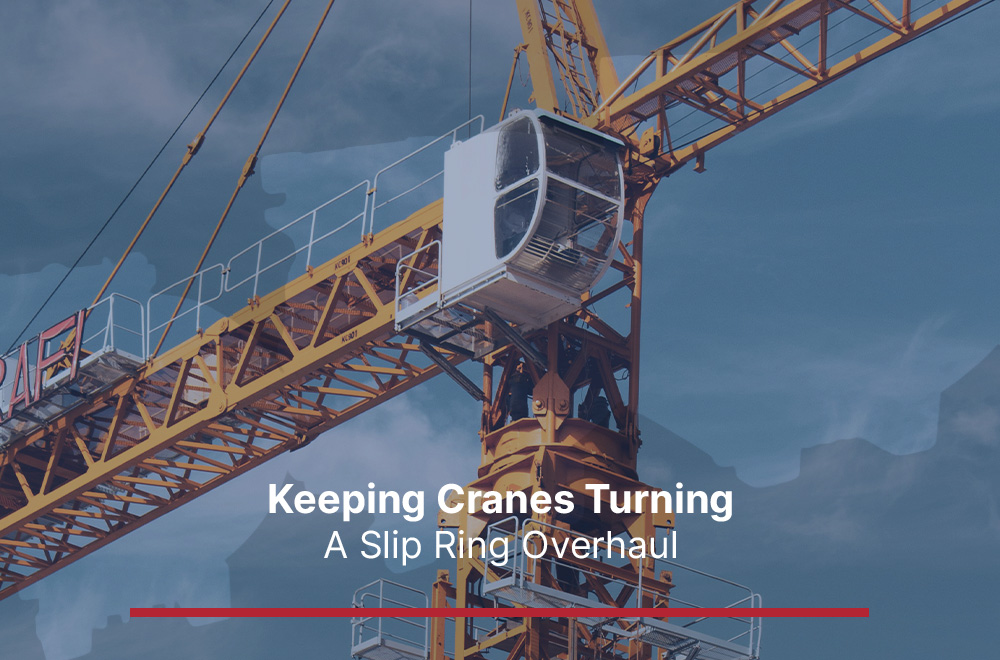
A tower crane spends its whole working life slewing. The top of the crane, the cab, jib and counterweight, rotates around the mast and never settles at a fixed point. That creates a problem. You cannot run fixed cables across a joint that turns endlessly, because they would wind up and tear themselves apart. The answer is the slip ring.
Slip rings, also called collector rings, carry power and control circuits across the rotating joint inside the slewing unit, so the crane can turn without limit. They are the quiet workhorse of the slew. When they are in good order, nobody gives them a thought. When they are not, the crane stops, and on a live site a stopped crane holds up everything happening below it.
That is the position a tower crane hire customer was in. Two slewing-unit slip ring assemblies came to us for a full strip-down, inspection and rebuild, with one bound for a coastal site that would need extra corrosion protection.
The slip ring lives in the slewing unit, right on the axis the crane turns about, between the static mast and the rotating superstructure above it. Power for the hoist and slew motors, plus the control and signal circuits that tell the crane what to do, all pass through it. Lose one ring or one circuit and the crane can stop dead, at height, mid-shift.
The slewing unit sits at the top of the mast. The slip ring inside it carries power and control across the rotating joint, letting the jib slew through full rotation without winding up the cabling.
The first job with any slip ring repair is an honest look at what has actually failed, because the visible symptom is rarely the whole story. Across the two units, we found a familiar pattern. The collector rings showed scoring, discolouration and pitting where the brushes had been running, and on one unit, a ring surface had broken down badly enough to interrupt clean contact.
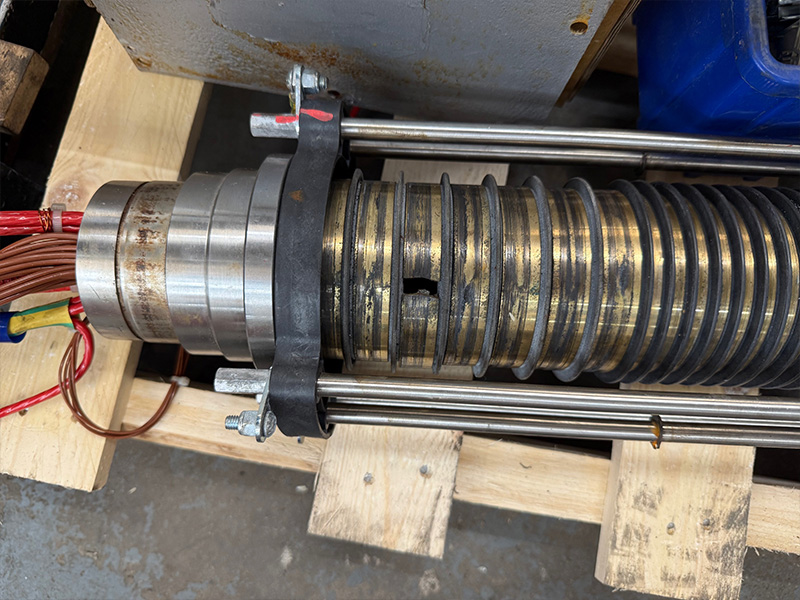
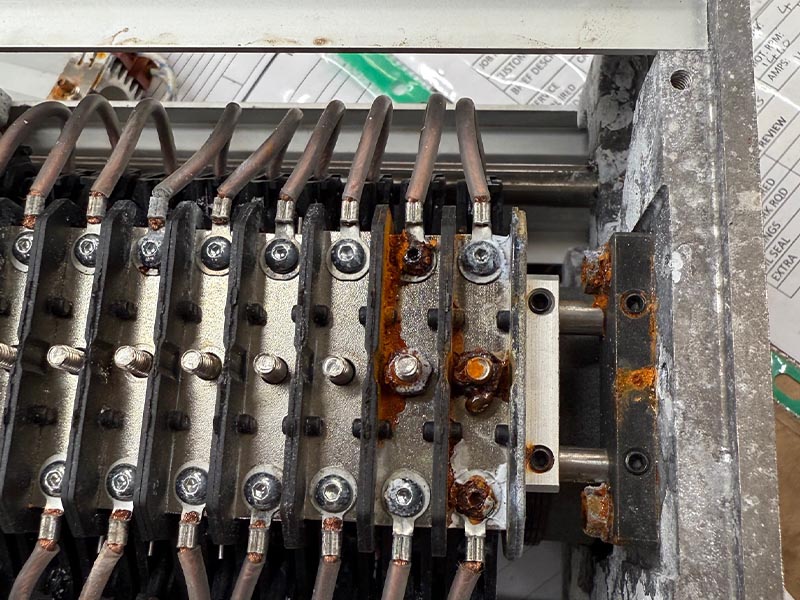
The brush-gear told the same story: worn brushes, tired flexible leads and contact pressure no longer doing its job. The connection busbars had oxidised, which quietly adds resistance and heat at exactly the points that should be carrying current cleanly. That matters more on a crane than most places, because the collector sits outdoors, exposed to rain, dust and salt air, and moisture ingress is the fastest route to insulation breakdown. On the mechanical side, the bearing tracks were scored, so simply dropping in new bearings would not have given a true running fit.
Both assemblies were taken right back to component level. We removed the side panels and earth straps, lifted out the slip ring busbars for dismantling and inspection, and took off the power-side busbars and box for cleaning and assessment. With everything apart, the brush track was checked electrically and the brushes assessed, the rings inspected visually, and the insulation resistance tested to find any breakdown hidden inside the build.
Every part that could be saved was cleaned and polished rather than replaced, which keeps the repair cost-effective and respects the original engineering. Anything past its usable life was earmarked for replacement.
This is where a workshop repair earns its place over a straight parts swap. Rather than condemn the housings, we machined the bearing tracks true to remove the scoring, then fitted oversize bearings to restore a precise, properly supported running fit. The collector rings were set up and skimmed on the lathe, taking the surfaces back to clean, concentric tracks for the new brushes to bed onto.
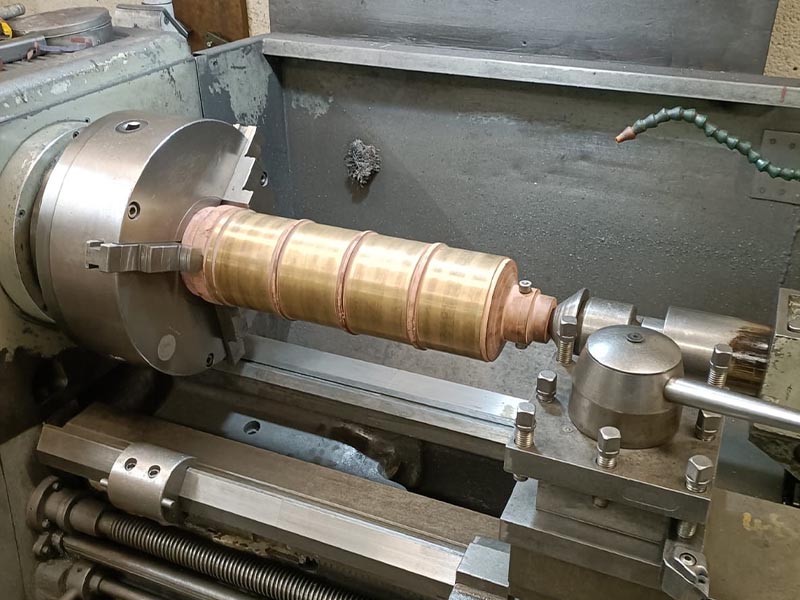
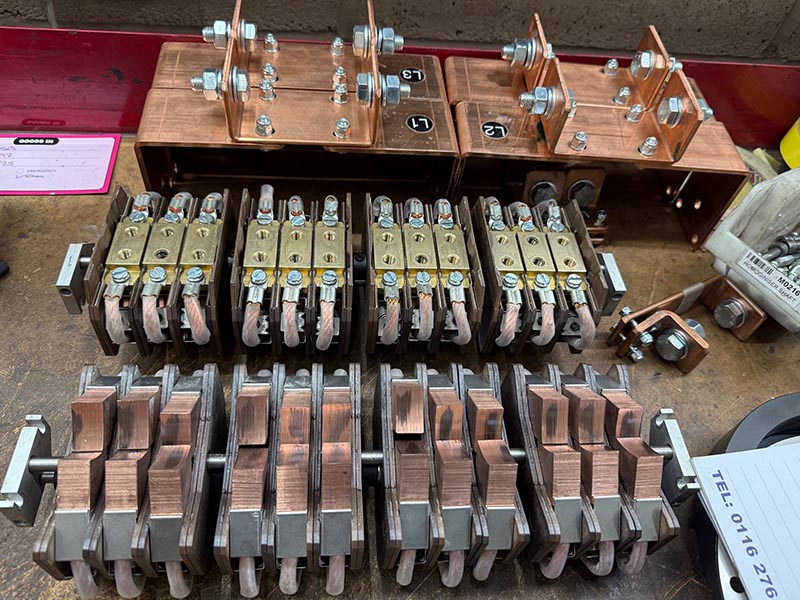
Restoring surfaces by machining, rather than scrapping a serviceable casting, is often the difference between a sensible repair and an unnecessary replacement bill. It is also why a worn collector is so rarely a write-off.
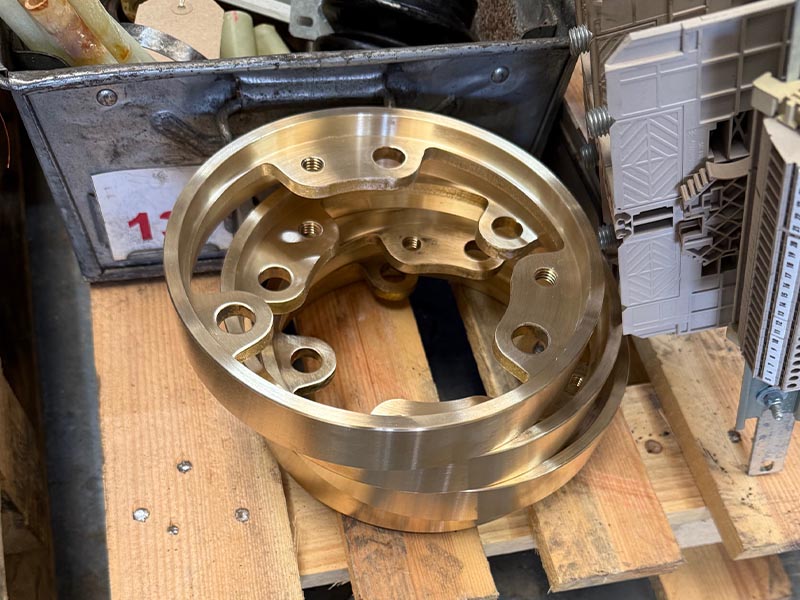
With the parts restored, the units went back together to a defined sequence. New bearings were fitted throughout, with new oil seals and a new encoder coupling on the unit that carried one. The slip rings and brush-gear were reassembled, and the busbars rebuilt using conductive paste before being refitted to the case, along with the power-side box and its busbars. Conductive paste at the joints matters more than it looks, because it keeps the electrical path low-resistance and resists the oxidation that started the trouble in the first place.
The coastal-duty unit was finished in marine paint to slow the corrosion that comes with salt-laden air, the sort of environment a crane on a dockside or seafront site lives in. Finally, each assembly was tested once built, confirming a clean, fully insulated unit reading to earth before it left the bench.
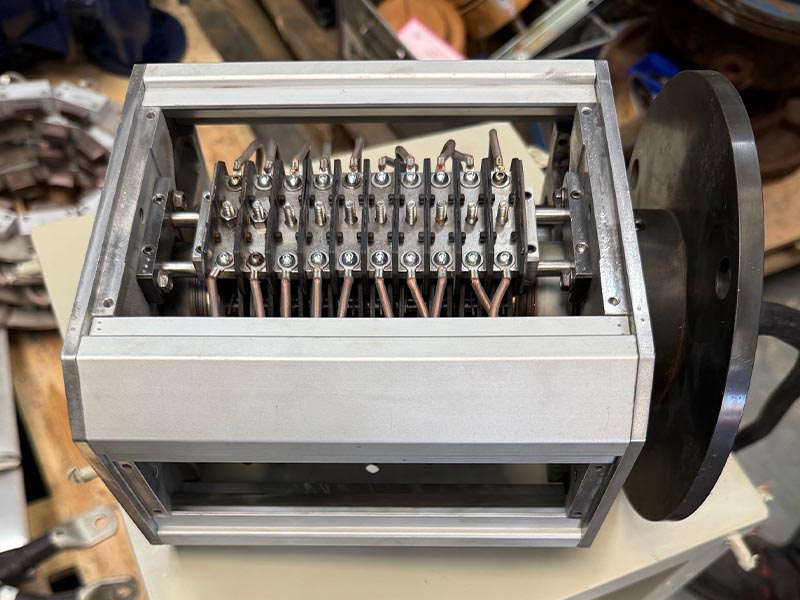
Both slip ring assemblies went back to the customer overhauled, protected and fully tested, ready to drop straight back into the slewing unit. For a crane hire fleet that is the whole point. A down crane stops a whole site, replacement collectors can be long-lead items, and the overhauled unit comes back as a known quantity, quickly, at a fraction of the cost of new, with the asset life extended by years rather than scrapped.
We repair and refurbish slip rings for tower crane and gantry slewing units, as well as motor and non-motor applications, in our Leicester workshop or on site at height. Free initial inspection, clear reporting, and collection and return across the UK.