
What Is a Variable Speed Drive and Could It Cut Your Energy Bills?

How variable speed drives cut energy use on fans and pumps, which applications benefit, and what to check before fitting one.
November 4, 2026
Header image

Energy is one of the few plant costs you can still do something about. You have limited say over the unit price, but you have a lot of say over how much your equipment actually uses. That is why variable speed drives keep coming up in conversations about industrial energy savings, and why they are one of the first things we look at when a customer asks us where their money is going.

The Carbon Trust's motors and drives technology overview guide puts the scale of it plainly: citing the World Energy Council, it reports that electric motors and motor-driven systems account for around 70% of electricity consumption in industry, and close to half of all electricity use globally. If most of your consumption sits in rotating equipment, that is where the opportunity sits too.

How an AC variable speed drive works

A variable speed drive, also called a VSD, inverter or variable frequency drive, sits between your electrical supply and your motor and controls the speed the motor runs at.
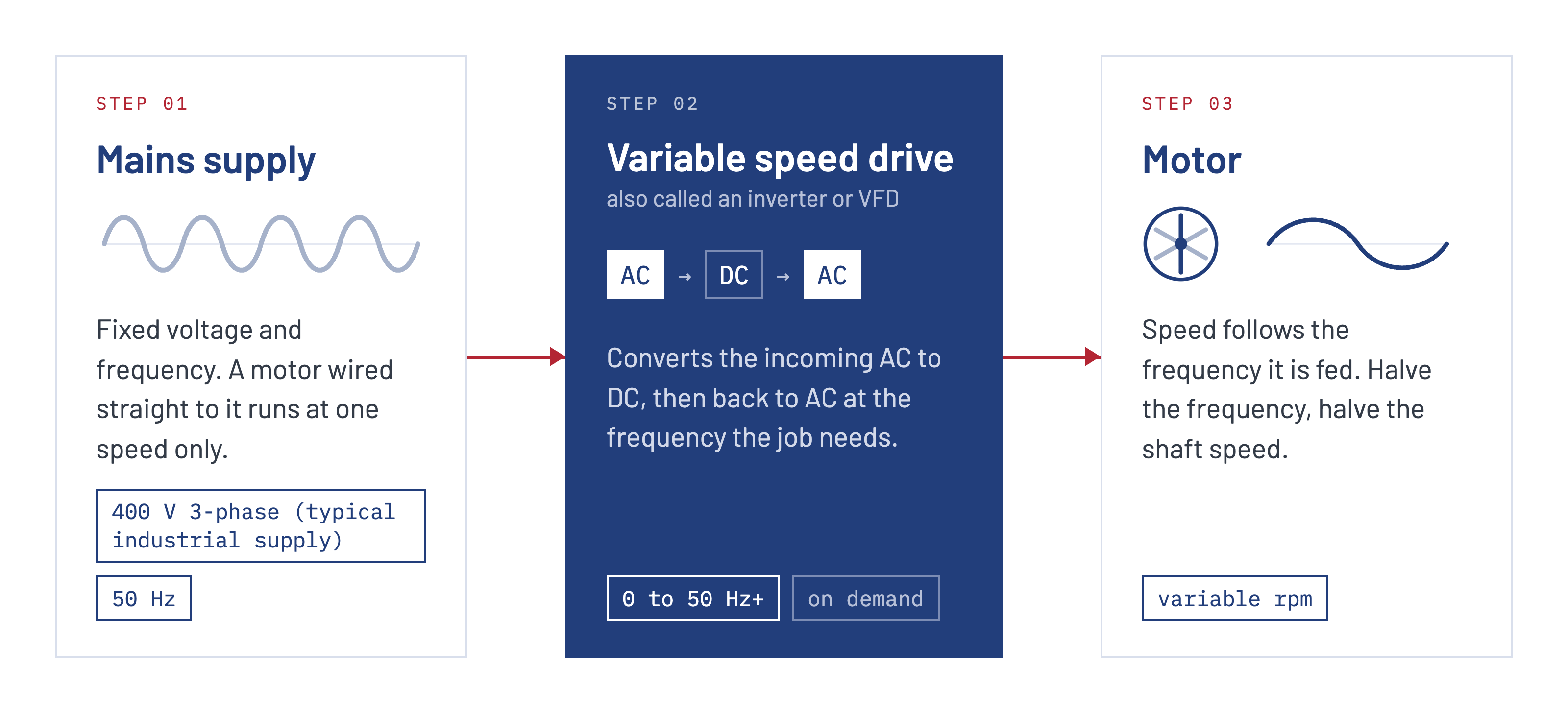
Diagram showing the three stages of an AC variable speed drive: a fixed 50 Hz mains supply feeds a drive that converts AC to DC and back to AC at a variable frequency, which then runs the motor at variable speed.

An AC induction motor runs at a speed set by the frequency of the supply feeding it. Give it a fixed 50 Hz supply and it runs at one speed, all day, whether the process needs that output or not. A drive rebuilds that supply at a frequency of its choosing, so the motor can run at whatever speed the job actually calls for.

That gives you control over output rather than control over waste. Instead of running a fan flat out and closing a damper to cut the airflow, you slow the fan down and stop generating the airflow you are throwing away in the first place.

Inside the drive

Three stages inside one enclosure do that conversion.
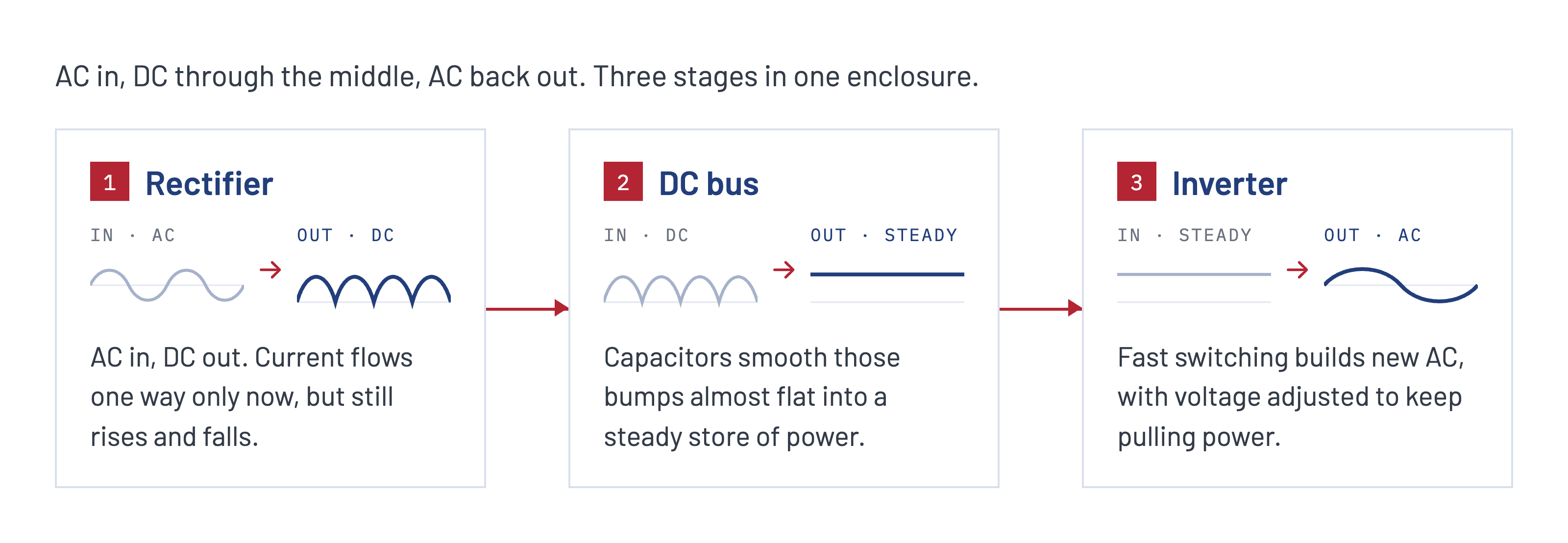
Diagram of the three stages inside a variable speed drive: a rectifier converting AC to DC, a DC bus smoothing it with capacitors, and an inverter switching it back into AC at the set frequency.

Where the energy savings come from

For centrifugal loads such as fans, blowers and centrifugal pumps, the relationship between speed and power draw follows the affinity laws. Flow drops in line with speed, but power drops with the cube of speed. Small reductions in speed produce disproportionately large reductions in energy use.

Motor speed Flow delivered Approximate power drawn
100% 100% 100%
90% 90% 73%
80% 80% 51%
70% 70% 34%
60% 60% 22%

In practical terms, taking 10% off the speed of a centrifugal load can cut its energy consumption by around 27%. Take 20% off and the reduction can reach around 48%, which matches the Carbon Trust's own figure of up to approximately 50% power saving from a 20% speed reduction on variable torque loads. Those are theoretical figures before drive losses and system effects, but they explain why the savings on fan and pump duties are often significant enough to justify the work on their own.

Which applications benefit, and which do not

Not every motor is a candidate. The savings depend on the type of load and how the equipment is currently being run.

Application Savings potential Why
Centrifugal fans and blowers with damper control High Affinity laws apply and the damper is currently wasting the airflow you paid to generate
Centrifugal pumps with throttling valves or bypass lines High Same principle. Slowing the pump beats restricting the flow downstream
Equipment with variable demand across a shift High The drive matches output to demand rather than running at full duty continuously
Conveyors and other constant torque loads Moderate Power falls roughly in line with speed rather than with the cube of it, so savings are smaller but control benefits remain
Equipment with heavy stop-start cycling Moderate Controlled acceleration reduces peak current and mechanical shock loading
Motors already running at full load, full time Low There is no surplus output to remove, and the drive itself adds a small loss

The quickest indicator on a walk round the plant is a throttled valve, a partly closed damper or a bypass loop running continuously. Every one of those is a sign that the motor is producing more than the process needs.

The benefits that are not on the electricity bill

Energy is usually the reason a VSD gets specified, but it is rarely the only benefit.

  • Controlled starting. Direct on line starting draws a heavy inrush current and puts a sharp mechanical shock through couplings, belts, bearings and gearboxes. A drive ramps the motor up instead.
  • Better process control. Speed can be trimmed to the duty, or driven from a pressure, flow, level or temperature signal so the equipment self-regulates.
  • Reduced mechanical wear. Lower average speed and softer starts mean less stress on bearings, seals and drive components.
  • Fewer peak demand issues. Softer starting can help on sites where motor inrush is causing supply problems.

What to check before fitting one

A drive is not a component you simply bolt on and walk away from. There are a handful of practical points worth working through first.
  • Motor suitability. Older motors were not always built with inverter duty in mind. The fast switching of a drive puts extra stress on winding insulation, and long motor cables can make that worse. Shaft voltages and bearing currents also need consideration on larger machines. If your motor is due for attention anyway, it is worth reviewing its condition and its efficiency class at the same time. Our guide to IE2, IE3 and IE4 efficiency ratings covers what those classes mean in practice.
  • Cooling at low speed. Most standard TEFC motors are cooled by a fan on their own shaft. Slow the motor down, and the cooling drops away with it, which matters on loads that sit at low speed for long periods. Forced ventilation or a different motor selection may be needed.
  • Minimum speed limits. Pumps still need to meet system head and maintain suction conditions, and running too slowly can cause its own problems. The minimum speed should come from the system curve, not from a default parameter setting.
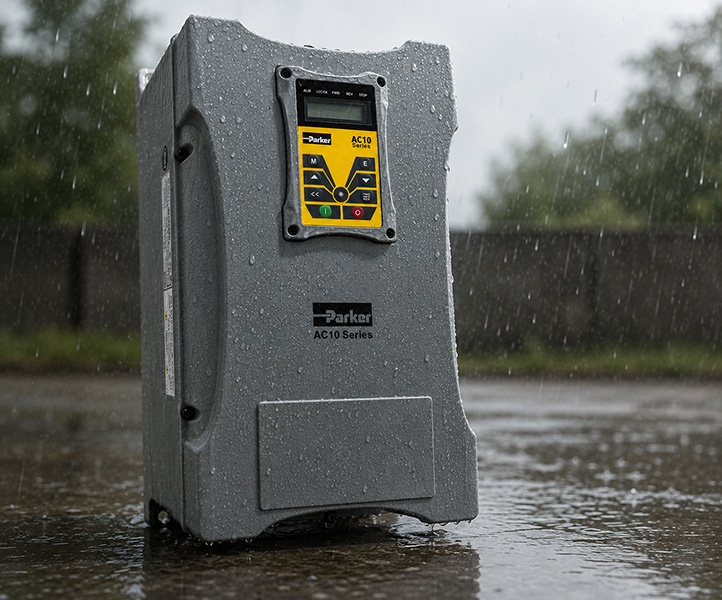
  • Installation environment. Drives generate heat and dislike dust, damp and washdown. Panel-mounted drives need enclosure sizing and ventilation designed properly. For outdoor, dusty or washdown areas, an IP66-rated drive can be mounted locally without an additional enclosure, which simplifies the installation.
parker drive IP66 sat in the rain outdoors
  • Electrical considerations. Screened motor cable, correct earthing and EMC practice all matter, as do harmonics on sites with several drives on the same supply.

How City Rewinds & Drives approach it

We supply, install and support AC and DC drives from manufacturers including ABB, Siemens, Danfoss, Schneider, Vacon and Parker, alongside servo drives, inverters and IP66 rated units for harsher environments. Just as importantly, we work on the motors, pumps, fans and gearboxes those drives are controlling, so the recommendation takes the whole drive train into account rather than the drive in isolation.

Our energy saving service runs in three stages:

  1. Audit and feasibility study. We look at your existing equipment, how it is being run and where the demand actually varies, then set out the realistic savings and where they come from.
  2. Specification and installation. We select and design the solution around your application, and our engineers handle removals, installation and commissioning on site, including any control panel work required.
  3. Commissioning and ongoing support. We set the drive up properly for the duty, then support it with maintenance, diagnostics and fault finding on motors, drives and panels.

We also carry out thermal imaging, vibration analysis and laser alignment on site, which often flags the equipment worth targeting first.

Talk it through with us

If you have fans running against dampers, pumps running against throttled valves, or a motor list you suspect is costing more than it should, we can look at the numbers with you before anything is bought.

Call the team on 0116 276 4949 or get in touch to arrange an energy audit. Our line is answered 24 hours a day for urgent repairs.


Stay up to date with the latest news and updates
Sign up to our newsletter today!
Thank you! Your submission has been received!
Oops! Something went wrong while submitting the form.
Thank you! Your submission has been received!
Oops! Something went wrong while submitting the form.